Educational Overview

Exploring Natural Compounds

A structured overview of major categories of natural compounds studied in the context of nutritional science and men's physiological well-being. Each category represents a distinct area of ongoing scientific inquiry.

Informational content only. No products are sold or endorsed.

Natural Compound Categories

Six Categories of Scientific Interest

The following categories reflect groupings used in nutritional and phytochemical research literature. Each card presents key characteristics and documented areas of scientific investigation without making claims about outcomes or applications.

Collection of whole adaptogenic plant roots including thick gnarled ashwagandha root, dried slices of eleuthero root, and raw rhodiola rosea root pieces arranged on dark grey slate with dramatic single-source lighting from the upper left creating rich textures and shadows
Category 01

Adaptogenic Botanicals

A grouping of plant-derived compounds, primarily roots, that have been studied for their interactions with stress-response physiological systems, particularly the hypothalamic-pituitary-adrenal axis. The category includes some of the most historically documented botanicals in traditional knowledge systems across Asia and Eastern Europe.

  • Key representatives include Panax ginseng, Withania somnifera, Rhodiola rosea, and Eleutherococcus senticosus, each with distinct constituent profiles.
  • The concept of adaptogenesis was formalised in 20th-century pharmacological literature, originally exploring the notion of nonspecific stress resistance.
  • Active constituent classes vary by species: ginsenosides in Panax ginseng, withanolides in ashwagandha, rosavins and salidroside in Rhodiola.

Learn More
Macro close-up of natural mineral specimens including a crystalline zinc ore sample, lustrous selenium deposits, and rough magnesium mineral fragments arranged on a dark textured background with focused light highlighting the crystalline surfaces and mineral colours
Category 02

Essential Trace Minerals

Inorganic elements required in small but specific quantities for the correct functioning of enzymatic processes, structural proteins, and hormonal systems. Despite being needed in trace amounts, deficiencies in these elements have been associated with measurable physiological changes in multiple organ systems.

  • Zinc participates as a structural or catalytic component in approximately 300 documented human enzymes, spanning metabolic, immunological, and reproductive pathways.
  • Selenium is incorporated into a distinct category of proteins, selenoproteins, as the amino acid selenocysteine, which is encoded by UGA codons.
  • Geographic soil composition significantly affects the selenium and iodine content of locally grown plant foods, creating region-specific intake variations across Europe.
Learn More
Overhead flat lay of polyphenol-rich foods including dark red pomegranate seeds, a cup of dark green matcha tea, fresh blueberries, raw cacao nibs, and dried green tea leaves on a textured linen cloth with soft natural diffused light
Category 03

Antioxidant Polyphenols

A large and chemically diverse class of plant-derived secondary metabolites characterised by the presence of multiple phenolic ring structures. Polyphenols represent one of the most extensively studied groups of dietary bioactive compounds in contemporary nutritional research, with several thousand individual compounds identified across the plant kingdom.

  • The major subclasses include flavonoids (quercetin, kaempferol, EGCG), stilbenes (resveratrol), lignans, and phenolic acids, each with distinct metabolic fates.
  • Gut microbiota play a significant role in polyphenol biotransformation, producing secondary metabolites that may exhibit different biological activities than the parent compounds.
  • The bioavailability of polyphenols is generally modest and highly variable, influenced by the food matrix, cooking methods, and individual microbiome composition.
Learn More
Still life arrangement of omega-3 rich natural food sources including a whole salmon fillet on ice with visible pink flesh, a small bowl of flaxseeds, walnuts in their shells, and a dark green avocado half on a marble surface with cool natural light
Category 04

Omega Fatty Acids

Polyunsaturated fatty acids characterised by their carbon chain length and the position of double bonds. The omega-3 and omega-6 families are classified as essential fatty acids, meaning the human body cannot synthesise them endogenously and they must be obtained through dietary sources. The omega-3 to omega-6 intake ratio has been a subject of considerable nutritional research.

  • The principal omega-3 fatty acids include ALA (alpha-linolenic acid, from plant sources), EPA and DHA (from marine sources), with ALA-to-EPA/DHA conversion efficiency being notably limited in humans.
  • DHA is the predominant structural fatty acid in the phospholipid membranes of neural tissues, where it is thought to influence membrane fluidity and receptor function.
  • EPA and DHA are precursors to a class of signalling molecules called eicosanoids, including prostaglandins and resolvins, involved in inflammatory resolution pathways.
Learn More
Flat lay of B-vitamin rich whole foods including a halved hard-boiled egg with golden yolk, a portion of cooked lentils, sunflower seeds in a ceramic bowl, dark nutritional yeast flakes, and a cross-section of beef liver on a dark wooden chopping board with warm kitchen lighting
Category 05

B-Vitamin Complex

Eight chemically distinct water-soluble vitamins, grouped together under the B designation due to their historical co-discovery and co-occurrence in many food sources. Each B vitamin has unique biochemical functions, absorption mechanisms, and dietary sources, but they are frequently studied in relation to energy-yielding metabolism and neurological processes.

  • Vitamin B12 (cobalamin) is unique among vitamins in requiring a specialised gastric protein, intrinsic factor, for intestinal absorption, and is found reliably only in animal-derived foods.
  • Folate (B9) is essential for one-carbon metabolism and nucleotide synthesis; its synthetic form, folic acid, exhibits distinct pharmacokinetics compared to naturally occurring food folates.
  • Niacin (B3) can be synthesised endogenously from the amino acid tryptophan, though the conversion efficiency is limited and requires adequate riboflavin, B6, and iron as cofactors.
Learn More
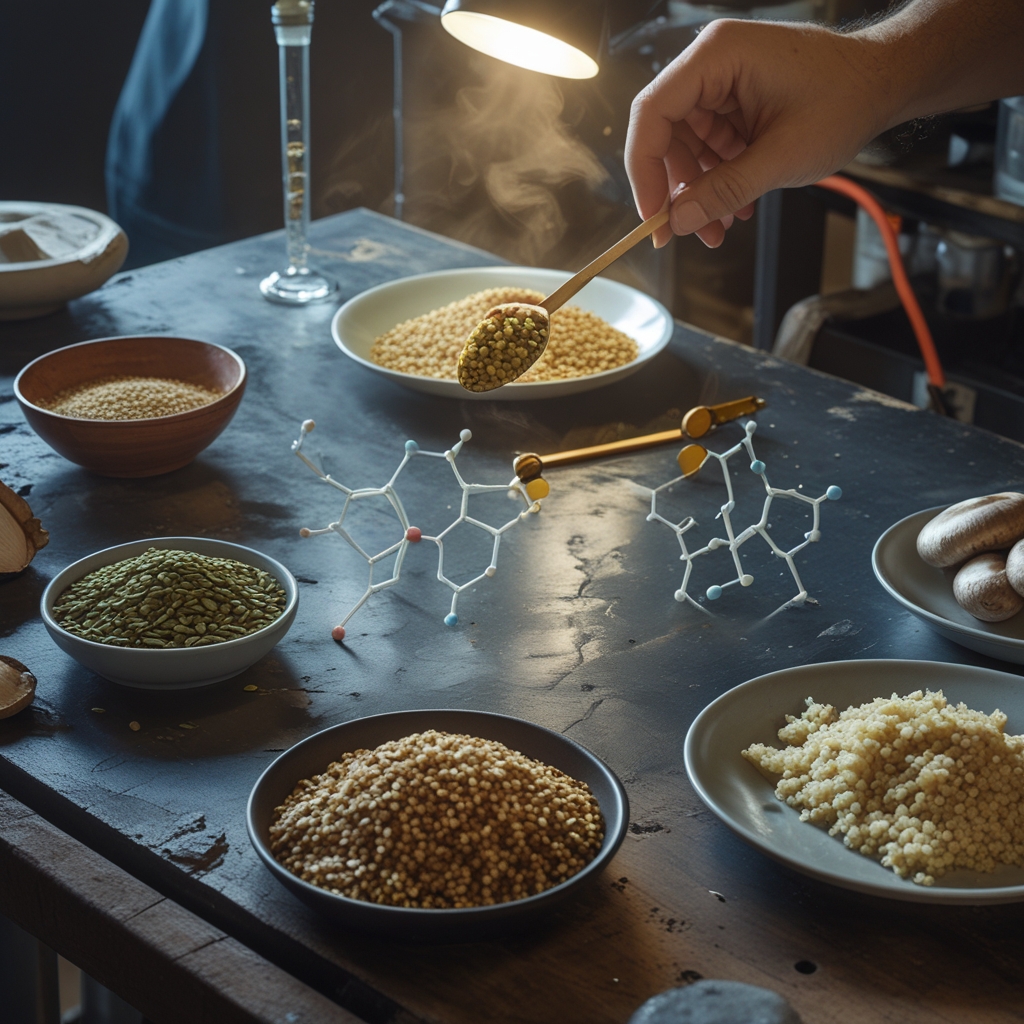
Scientific still life with a molecular model of an amino acid structure in foreground, surrounded by natural protein-rich food sources including a small bowl of hemp seeds, a portion of cooked quinoa, and dried mushrooms on an aged wooden science laboratory bench with warm focused laboratory lighting
Category 06

Conditionally Essential Amino Acids

Amino acids that the body can synthesise under normal physiological conditions but which may require dietary supplementation under certain circumstances, including specific physiological states or increased demands. Several amino acids in this category have attracted research attention for their roles in protein synthesis, nitrogen metabolism, and as precursors to important physiological signalling molecules.

  • L-Arginine serves as the sole endogenous precursor to nitric oxide via the nitric oxide synthase enzyme pathway, with implications for cardiovascular and immune research.
  • L-Glutamine is the most abundant amino acid in human blood and muscle tissue, playing roles in nitrogen transport, immune cell fuel provision, and intestinal barrier maintenance.
  • Glycine is involved in the synthesis of creatine, glutathione, and haem, and constitutes approximately one-third of the total amino acid composition of collagen protein.
Learn More
A Note on Evidence

How to Interpret Nutritional Research

The categories presented on this page represent areas of active and ongoing scientific investigation. The presence of a compound category here reflects its documented place in nutritional science literature, not a statement about efficacy for any particular purpose.

Nutritional research is inherently complex. Human studies frequently contend with confounding variables including dietary variation, lifestyle factors, genetic heterogeneity, and measurement challenges. Results from one population do not automatically translate to others. In vitro findings do not reliably predict in vivo outcomes. The quality of evidence for different compounds varies considerably.

Readers are encouraged to distinguish between associative findings (which show a relationship between two variables) and causal findings (which establish that one variable directly influences another). The former is far more common in nutritional epidemiology; the latter requires carefully controlled experimental designs and replication.

Informational Context

This content is for informational purposes only and does not constitute individual medical or health advice. The information presented explores various approaches to well-being and should not replace personal decisions or professional consultations.